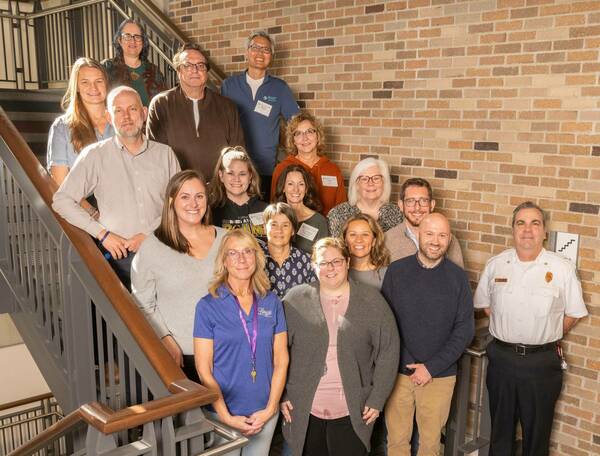
On Monday, November 3, community collaborators from the South Bend-Elkhart region gathered with University of Notre Dame researchers and staff on the Notre Dame campus for a community engagement workshop for Notre Dame Serving Community Analytical Needs (ND-SCAN), organized by the ND Sensor Initiative (NDSI). A total of eight local community organizations participated, including Beacon Health System, the City of South Bend, Life Treatment Centers, Marshall County HOPE, Naxos Neighbors, Oaklawn, the South Bend Fire Department, and the St. Joseph County Department of Health.
ND-SCAN is led by Nosang Myung, the Bernard Keating-Crawford Endowed Professor in the Department of Chemical and Biomolecular Engineering, and Marya Lieberman, the Nancy Dee Professor of Cancer Research in the Department of Chemistry & Biochemistry. It is a critical part of the Notre Dame Sensor Initiative (NDSI) and the 2033 Strategic Framework’s health and well-being investment. ND-SCAN focuses on developing sensor technologies that can efficiently and effectively detect psychoactive substances present in compounds, such as illicit drugs. This sensing technology will allow community stakeholders, including healthcare providers and harm reduction groups, to quickly identify and respond to changes in illicit drug supplies by collecting and submitting samples of substances found locally for testing.
"As a force for good, NDSI helps to empower first responders who are on the front lines of the opioid crisis. We provide our community partners with vital data on illicit drug trends, enabling them to make informed, life-saving decisions for patient care," said Myung, highlighting the close connection between researchers and community partners that this initiative requires.
Through ND-SCAN’s expanding abilities to test the composition of drugs, including opioids, Notre Dame researchers aim to provide community-relevant information and resources to support the efforts of regional organizations. This workshop aimed to pool existing community knowledge to guide ND-SCAN activities to support research outcomes that align with community needs and are most useful to community stakeholders in their on-the-ground work.
“Understanding what is in the local, unregulated drug supply is a critical and yet enormous task. People's lives depend on our community understanding the risks of these constantly changing contaminants. ND-SCAN is bringing the right people together with the right tools to develop a knowledge network that can help to stop overdoses before they happen,” said Joanne Cogdell, CEO of Naxos Neighbors.
The meeting began with an overview of the ND-SCAN vision and capabilities, followed by a guided group discussion. Group discussion question topics included what information about the local drug supply would be most useful or actionable, what substances are of the greatest concern and should be tested for, and what logistical concerns participants had regarding sample collection, storage, shipment, and follow-up. After a lunch break, meeting attendees toured multiple labs on campus where ND-SCAN and NDSI research is being completed. Myung and Lieberman offered closing remarks to wrap up the meeting.
NDSI and the participating community organizations plan to continue and expand their collaboration by holding another meeting in six months. Additional community organizations will be invited to engage as well so that Notre Dame researchers can gather even more insight into on-the-ground priorities, needs, and knowledge. In the meantime, logistics and information sharing procedures will be explored.
To learn more about NDSI and ND-SCAN, please visit the NDSI website.